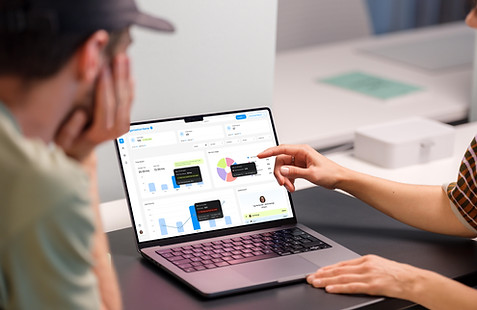
Wikipedia: End-to-end feature to nudge readers to explore and critically engage with relevant articles.
Collaborating with The Wikimedia Foundation, our team of social innovators explored their ecosystem to identify opportunities for innovation. We discovered a gap in the education system and developed a new Wikipedia feature that promotes exploratory learning, critical thinking, and the formation of educated viewpoints.

Product Design & Research

8 months

6 teammates

The Wikimedia Foundation is the San Francisco-based nonprofit behind Wikipedia, the world's largest free knowledge platform, reaching ~20 billion readers monthly.
Wikipedia: Connect the Dots


What opportunities exist within Wikipedia to engage Gen Z?
Wikipedia can evolve beyond an information repository to become a dynamic platform that empowers Gen Z, while maintaining trust in its open-source knowledge ecosystem.
INITIAL RESEARCH
What do 407M Gen Z Wikipedia users want?
75%

RESEARCH PARTICIPANTS COULD NOT USE WIKIPEDIA FOR RESEARCH
38%
GEN Z CONSIDERS CRITICAL THINKING IMPORTANT


IMPACT
What will this feature change?
This feature has the potential to help Gen Z readers engage with diverse content and discover relevant topics while encouraging them to critically engage with information.
30%
INCREASE IN USERS VISITING 3 OR MORE ARTICLES IN ONE SESSION
25%
USERS ENHANCING THEIR CRITICAL THINKING SKILLS

RESEARCH
How did we involve Gen Z in the process?
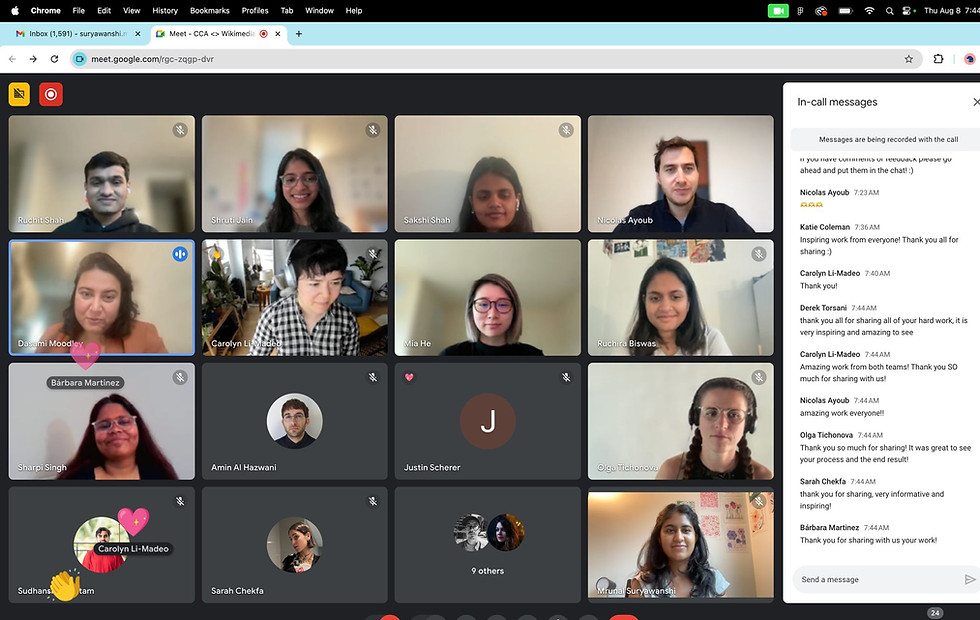
We collaborated with the Center for Art and Public Life, connecting with various institutions like short-term degrees, language and skill-based schools, and many knowledge seekers. This enabled us to host 3 workshops, virtual and in-person, with 50 participants globally.
50+ learners across
4 countries
We engaged learners globally all throughout the process of building and testing the new feature.


4+ months of research with 3 co-design workshops
RESEARCH
Co-design workshops to better understand our users
We partnered with the Center for Art and Public Life to conduct 3 co-design workshops with over 20 learners aged 12-26. Each workshop featured four interconnected activities structured as a narrative. The goal was to identify Gen Z's needs, education ecosystem gaps, and how resource availability impacts their personal learning journeys.
1. Learning Roadmap
Understanding users learning patterns and processes.


2. Learning Stations
Identifying platforms and tools they instantly turn to for learning new things

3. Build your own toolkit
Asked them to build a learning toolkit for GenZ
4. Co-Design
Co-design the best way for Gen Z to learn new information

RESEARCH
Gen Z's learning preferences identified from our research
.jpeg)
Critical thinking
Autonomy
Finding their voice
Exposure
Forming perspectives
Personalisation

This helped us frame the problem
How can we empower Gen Z to build an educated point of view using Wikipedia as a tool?
CONCEPT TESTING AND EARLY IDEAS
We validated our ideas before building
This testing aimed to understand how people explore topics and identify their preferred learning methods. We presented readers with three types of articles and prompted them to explore, reflect, and discuss at various points, observing how their understanding evolved and what they sought in the content.


INSIGHTS
Testing helped us define the "breadth of a point of view"
It helped us come up with 5 key indicators of success for an arbitrary term like forming a perspective.
-
Sparking interest in a topic
-
Nudge them to explore the topic
-
Critically thinking about the information
-
Making users feel or connect with the information and reflect on it
-
Getting different viewpoints on a single topic

Translating insights into design
Connect the dots helps users navigate related Wikipedia content, making it easier to understand complex information and form a well rounded view point.
FINAL DESIGNS
Connect the dots - Article page
When readers click on "Dive Deeper," they see a split-screen view that presents curated information related to the article for quick understanding.This feature allows them to easily explore multiple perspectives with just a click.

FINAL DESIGNS
Timeline and compiled resources
We developed an interactive timeline to highlight key historical milestones, aiding users in understanding event chronology.
Additionally, we curated essential points from relevant articles into categories, allowing readers to explore all sides of the information and form an educated perspective.

FINAL DESIGNS
Exploring perspectives - Hubs
The goal was to create a space for meaningful idea exchanges by enabling users to engage in discussions and explore diverse perspectives.
Hubs allow individuals to join interest-based groups, fostering pro-discussion environments where they can drive conversations and access relevant articles that inform their perspectives.

TESTING AND ITERATIONS
What did not work out and had to be changed?
To identify user experience issues and enhance navigation, we conducted usability testing with 10 users, which helped us identify various usability issues with two consistent big problems: content design and visibility of the new feature.

CONTENT DESIGN AND VISIBILITY OF THE NEW FEATURE WERE THE TWO BIGGEST CHALLENGES
Visibility of a new feature
Content design
Userflow felt long
Less intuitive
Certain features felt less pertinent

TESTING AND ITERATIONS
We made changes to address the two core issues identified from usability testing
After 8 iterations, the final feature was designed as a split-screen view instead of a progressive disclosure, making it easier and more seamless for readers to explore and match their expectations. We also talked to SMEs to carefully craft neutral content and copy.

Iteration 1
Involved many steps to reach the main feature

Iteration 5
Users could not comprehend what to expect

Iteration 3
Did not have a seamless connection with the compare button

Final Version
Seamless integration with neutral content design
LEARNING AND REFLECTIONS
What did my time at wikipedia teach me?
-
Balancing user needs with business priorities, learned through constructive disagreements and alignment with my Design Manager.
-
Simplifying complex user flows through iteration, not first-pass perfection.
-
Facilitating international co-design workshops, both in-person and remote.
-
Designing within long-term organizational strategy, aligning work with Wikimedia’s 2026 Movement Strategy.
-
Designing within a legacy product, using design systems for faster execution while iterating to meet established patterns.
-
Not all work ships—and that’s not failure, but often a foundation for future teams and ideas.

Explore Other Projects
.jpeg)
Health Tech · Consumer Product · AI · 0 to 1